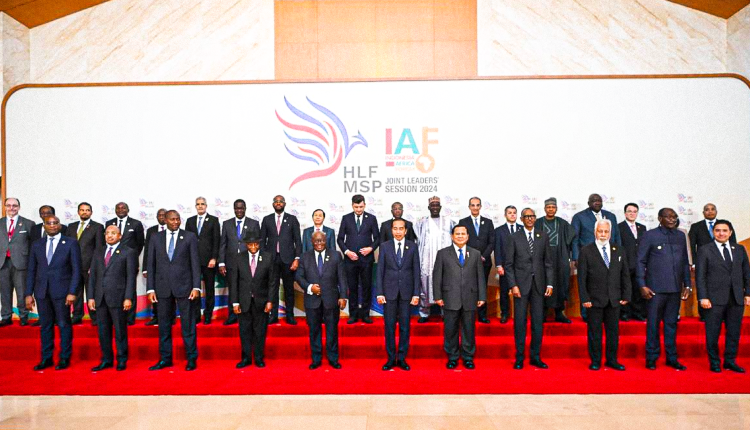
Indonesia-Africa Summit 2024
[ by Bahauddin Foizee ]
The global shift toward green infrastructure and advanced defence technologies has intensified competition over the materials essential to these industries. The modern military systems, from the precision-guided weapons and radar networks to the sophisticated electronics, require a steady supply of specialized minerals and components.
For decades, the major powers have maintained a dominant position in critical mineral and rare earth supply chains, leaving the resource-rich developing countries exposed to the global market uncertainties and with limited control over the value of their own natural resources.
However, a major geopolitical shift is underway. Indonesia and a coalition of African nations are moving away from their historically passive roles in global resource markets and embracing ‘resource nationalism’. This strategy involves governments asserting greater control over the natural resources within their borders. Alongside this approach, these countries are also pursuing cross-continental military-industrial cooperation.
Indonesia has reshaped the global mining landscape through its aggressive policy of hilirisasi, or downstreaming. By imposing strict export bans on raw ore, particularly nickel, Jakarta has compelled global corporations to establish smelting facilities and high-value manufacturing plants within the country. The objective is to move beyond exporting unprocessed resources and capture more of the economic value generated through domestic processing and manufacturing.
This strategy is particularly important because Indonesia’s defence industry remains dependent on imported raw materials for armoured vehicles and transport aircraft, despite the country being the world’s largest nickel producer. Its efforts to break away from a resource-export model have resonated with the sub-Saharan African governments seeking to overcome similar economic constraints. This shared ambition has gained significant institutional backing.
The partnership received international recognition when UN Secretary-General Antonio Guterres officially launched the United Nations Country Support Mechanism on Critical Energy Transition Minerals. Designed by the UN Task Force, this initiative aims to help the developing countries move from exporting raw materials to establishing domestic processing industries.
Under this framework, Indonesia is paired with five African resource holders: Guinea, Madagascar, Nigeria, Zambia and Zimbabwe. Through this initiative, these countries are sharing regulatory expertise and policy frameworks to develop domestic refining capabilities and build higher-value industrial supply chains.
Although Indonesia controls a substantial share of the world’s nickel supply, achieving greater independence in its defence industry requires access to a broader range of specialized materials. These include rare earth elements and niobium, which are important for advanced military applications, including optical systems and missile-tracking components.
To secure access to these additional resources, Indonesia’s newly established state mining enterprise, PT Perusahaan Mineral Nasional (Perminas), operating under the national investment platform Danantara, has turned to Africa. The company signed a Memorandum of Understanding with Abu Dhabi-backed New Energy Metals to evaluate and develop the Maboumine polymetallic deposit in Gabon.
The proposed partnership aims to connect African mineral extraction with Indonesia’s domestic refining capabilities and permanent magnet manufacturing facilities, reducing the reliance on trading hubs dominated by the global superpowers.
This effort to strengthen resource security is accompanied by a parallel expansion of military-industrial cooperation. During a high-profile state visit to Jakarta in 2025, South African President Cyril Ramaphosa met with Indonesian President Prabowo Subianto to accelerate the implementation of their Indonesia-South Africa Defence Cooperation Agreement.
Citing growing global uncertainties, the two leaders prioritized the deployment of a joint technical delegation to advance the co-development of military technologies across land, air and sea domains, seeking to move the agreement toward practical implementation.
However, translating these agreements into tangible outcomes presents significant challenges. The agreement concerning the aforementioned Maboumine project remains a non-binding framework, and no final decision has been made on constructing the mine. This means that the proposed partnership has yet to progress from an agreement on cooperation to a confirmed mining project.
Technical limitations have also been complicating Indonesia’s ambitions. While the country has made progress in nickel processing, replicating that success with rare earth elements is considerably more difficult. Their separation and purification require highly complex chemical engineering capabilities that Indonesia is still developing.
Nevertheless, the combined use of state-backed mining enterprises, the UN-supported frameworks and defence cooperation agreements reflects a long-term effort by these middle powers to reshape global resource trade.
By strengthening their control over critical minerals, developing domestic processing capabilities and deepening military-industrial ties, Indonesia and its African partners are seeking to build greater strategic autonomy in a world increasingly shaped by competition among the major powers.