The Network Marketing Leader’s Guide to MLM Software in 2025
By Marcus Chen | Published on December 24, 2025Let’s be honest. If you’re running a network marketing company, your technology stack isn’t just a tool—it’s the central nervous system of your entire operation. The right MLM marketing software can fuel explosive growth, foster unshakeable distributor loyalty, and turn complex compensation calculations into a seamless background process. The wrong one can mean manual errors, frustrated teams, and a ceiling on your potential.
With over two decades in this industry, the team at FlawlessMLM has seen the evolution firsthand. We’ve moved from clunky, on-premise systems to agile, cloud-based platforms powered by AI. The conversation has shifted from just finding “MLM software” to finding the right MLM software solution that aligns with your specific compensation plan, growth stage, and vision.
This guide will cut through the noise. We’ll break down the key decisions you face—from understanding the core mechanics of Binary and Matrix MLM software to navigating the true cost of implementation. Our goal isn’t to sell you on a specific product, but to equip you with the knowledge to choose the platform that will be a true partner in your success. For many, that journey starts with a robust foundation in managing relationships and data, which is why exploring a dedicated mlm crm software solution is a critical first step for any serious network marketing business.
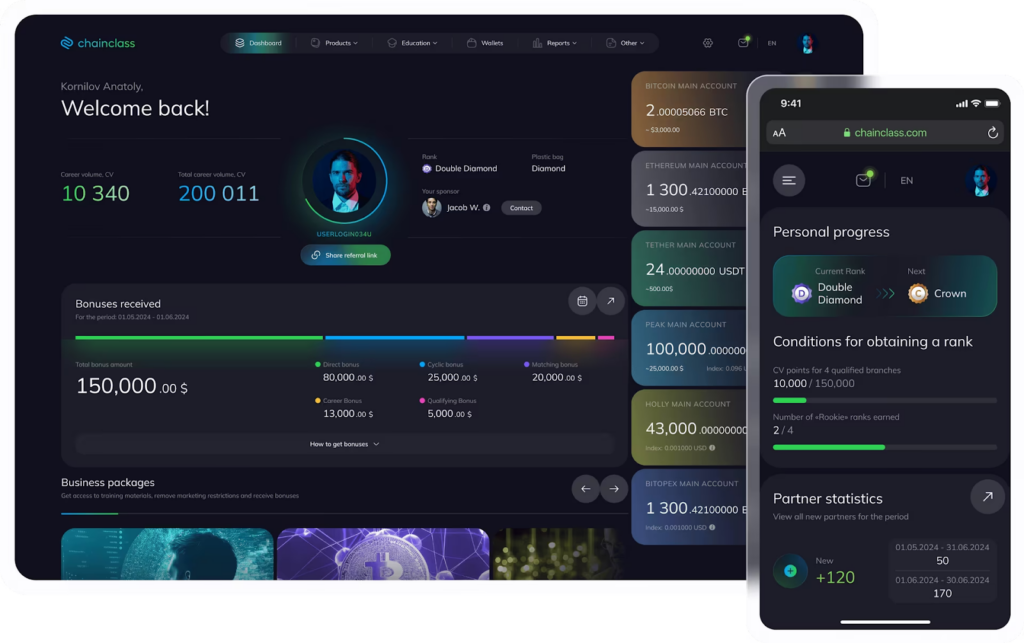
A modern MLM platform dashboard provides leaders with real-time insights into network performance and partner activity.
Beyond the Basics: Binary vs. Matrix MLM Software Unpacked
Your compensation plan is your company’s engine. It dictates how your distributors are rewarded and motivates their behavior. Therefore, the choice between a Binary MLM plan and a Matrix MLM plan is one of the most fundamental decisions you’ll make, and your software must be built to execute it flawlessly.
The Binary MLM Software: Simplicity and Speed
Imagine a structure where every distributor focuses on building just two front-line legs: Left and Right. This is the essence of the binary plan, renowned for its straightforwardness and potential for rapid, wide growth.
Binary MLM software is engineered to manage this two-legged genealogy tree. Its core algorithms are designed to handle “spillover,” where new recruits automatically fill empty positions in the weaker leg, a feature intended to promote teamwork and balance. The best binary MLM software companies build platforms that visually illustrate this balance, calculate matching bonuses from downline performance, and provide clear incentives for strengthening the weaker side.
Key Question for Your Business: Is your culture built on fast duplication, team collaboration to balance legs, and a simple plan that’s easy for new recruits to grasp? If yes, a binary structure—and software designed for it—might be your ideal starting point.
The Matrix MLM Software: Structure and Predictability
Now, imagine a plan with fixed dimensions, like a 3×7 matrix (3 spots wide, 7 levels deep). This forced structure offers controlled growth and predictable income paths. Once a distributor’s front line is full, new recruits “spill down” to their team members, benefiting the wider network.
Matrix MLM software specializes in managing these fixed-width, limited-depth structures. It automates the placement of new members, tracks level-based commission qualifications, and manages the completion of matrix cycles for bonuses.
Video: Understanding how different MLM compensation plans work in practice.
The Hybrid Trend and Your Software’s Flexibility
The most innovative companies in 2025 aren’t strictly choosing one or the other. They’re adopting hybrid models, perhaps using a binary structure at the top for fast expansion, with matrix systems within teams for stable depth. This is where your choice of MLM software development partner becomes critical. Can their platform adapt? The leading network marketing MLM software providers offer flexible MLM compensation plan engines that can be configured to support binary, matrix, unilevel, and custom hybrid plans without needing a full system overhaul.
ConsiderationBinary Plan & SoftwareMatrix Plan & SoftwareCore FocusFast growth, team balance, and wide networks.Controlled growth, depth, and predictable team structures.Ideal ForHigh-energy teams, products with quick onboarding, and a culture of mutual support to balance legs.Companies with premium products, longer sales cycles, and a focus on mentorship and depth.Critical Software FeatureReal-time leg volume tracking, spillover management, and clear weak/strong leg analytics.Automated level completion tracking, “spill-down” placement logic, and cycle bonus management.
Demystifying MLM Software Price and Budgeting for 2025
Asking “how much does MLM software cost?” is like asking how much a house costs. The answer depends on size, location, customizations, and amenities. Let’s move beyond vague quotes and look at what truly shapes your investment.
The Real Drivers of Cost
Your MLM software price is primarily determined by four factors:
- Plan Complexity & Customization: A standard binary or unilevel plan costs less to implement than a complex hybrid or fully custom plan. Every unique rule, bonus type, or qualification criteria requires development time. Custom branding, a white-label mobile app, or special MLM ecommerce software integrations also add to the cost.
- Scale & User Base: Are you launching with 100 distributors or 100,000? The infrastructure needed to support millions of transactions, real-time network marketing commission software calculations, and high-traffic dashboards scales accordingly.
- Deployment Model: Cloud-based (SaaS) solutions typically have lower upfront costs but ongoing subscription fees. On-premise installations require a larger initial investment for licenses and servers but may offer lower long-term costs and more control.
- Integration & Compliance: Need to connect to Shopify, a specific payment gateway, or an existing CRM? Each integration adds cost. So does building for global compliance (GDPR, taxes) and enterprise-grade security.
The Hidden Fee Alert: When evaluating low cost mlm software, scrutinize what’s not included. Common hidden costs include fees for additional admin roles, premium support SLAs, data migration from an old system, and future customizations or add-ons. Always request a detailed breakdown.
Building a Realistic Budget
For 2025, smart budgeting means looking beyond the initial sticker price. A realistic total cost of ownership includes:
- Initial Development/Setup: This is the core project cost, highly variable based on the factors above.
- Annual Support & Maintenance: Budget 15-20% of the initial software cost per year for updates, security patches, and technical support.
- Training & Onboarding: Don’t underestimate the cost of training your team and distributors to use the new system effectively.
- Scalability Reserve: Set aside funds for infrastructure upgrades as your user base grows.
This holistic view helps you compare providers accurately. The goal isn’t to find the cheapest mlm website price, but the solution that offers the best value and alignment with your growth trajectory for the next 3-5 years.
The Non-Negotiables: Features That Separate Good from Great
Once you understand plan support and pricing, it’s time to evaluate the feature set. The best network marketing software in 2025 does more than just calculate commissions. It acts as a complete growth ecosystem.
The Indispensable Core
Any credible platform must have a robust, accurate MLM commission software engine and a clear genealogy viewer. However, the standard has been raised. Look for:
- Integrated E-commerce & MLM CRM: Your mlm ecommerce software should be seamless, allowing distributors to sell, track orders, and manage customers directly from their back office. Similarly, built-in mlm crm tools for lead and contact management are essential for distributor productivity.
- A True Mobile Experience: A responsive website isn’t enough. A dedicated, full-featured mobile app for iOS and Android is now table stakes for keeping your distributed team engaged and active.
- AI-Powered Insights: The leading mlm marketing tool suites now include dashboards that do more than report history. They predict trends, identify at-risk distributors, highlight top performers, and offer actionable insights.
The FlawlessMLM Perspective: Building for Real People
In our experience, we’ve learned that technology must serve people. It’s not just about the most features; it’s about creating a mlm software solution that distributors actually enjoy using. This means intuitive interfaces, simplified onboarding flows that get new recruits started in minutes, and training modules (an “MLM Academy”) built directly into the platform to upskill your network.
Furthermore, in a globalized world, your MLM website development must think beyond borders. True multi-currency and multi-language support, along with integrations with local payment processors in your target markets, are what transform a domestic platform into a global one.
Making Your Choice: A Practical Checklist
Choosing your MLM software development partner is a strategic decision. As you evaluate options, from binary mlm software companies to full-service providers like FlawlessMLM, use this checklist:
- Does their platform demonstrably support our chosen compensation plan(s), both today and for future hybrids? Insist on a live demo using data similar to yours.
- Is the total cost of ownership clear, with all potential hidden fees discussed upfront? Get detailed, written proposals.
- Does the user experience feel intuitive for both administrators and distributors? Test the back office and a sample distributor portal. Remember, low adoption kills ROI.
- Can they provide case studies or references from companies at a similar scale or in our industry? Look for proven experience, not just promises.
- Do they feel like a true partner? Your software provider should act as a consultant who understands network marketing, not just a vendor selling code. Are they proactive, knowledgeable, and do they seem invested in your long-term success?
The landscape of network marketing software MLM is powerful and complex. By taking a structured approach—understanding your plan, budgeting transparently, and prioritizing features that drive distributor success—you can move beyond confusion to confidence. The right software isn’t an expense; it’s the infrastructure that will carry your vision forward.
Marcus Chen is a business technology analyst who has followed the direct selling software space for over a decade. He writes about the intersection of scalable technology and human-centric business models.